IAC - Plumbing the inlet?

For discussing injector selection,manifold modifications, throttle bodies, fuel supply system design and construction, and FIdle valves and IACs.
Forum rules
Read the manual to see if your question is answered there before posting. Many users will not reply if the answer is already available in the manual.

If your question is about troubleshooting, configuration, or tuning, you MUST include your processor type (MS-I or MS-II) and code version in your post. If your question is about PCB assembly or modifications, you must also include the main board version number (1.01, 2.2 or 3.0).

If you have questions about MS1/Extra or MS2/Extra code configuration or tuning, please post them at www.msextra.com Such questions posted here will be moved to: a temporary MSextra sub-forum, where they will be removed after 7 days

The full forum rules are here: Forum Rules, be sure to read them all regularly.
Post Reply
GS guy
MegaSquirt Newbie
Posts: 21
Joined: Tue Sep 27, 2005 5:15 am
Location: Maryland

IAC - Plumbing the inlet?

Post by GS guy »

I have the remote mount DIYAutoTune IAC housing and Jeep valve. Intending to run this on a turbocharged Subaru engine.
I wanted to do away with the bulky OEM IAC valve both for aesthetic reasons and to simplify the installation for Megasquirt control. While deciding where to plumb the air inlet for the valve it occurred to me this could be a problem.
My original plan was to plumb it to the air intake tube, between air filter and turbo. Location is good, already filtered air - seemed like a good plan. As I though through the dynamics during operation though, maybe not such a good idea - if the valve has any leakage you have a perpetual manifold leak, bleeding off boost pressure? Anytime the valve is open (during warm-up) at least a large part of any boost created would be bled off. Any (even slight) leakage when the valve is closed - the perpetual leak situation. :(

OK, so what if we plumb it downstream of the turbo, between turbo and throttle body. In that situation you wouldn't encounter the perpetual leak since both sides of the valve would be under pressure. This sounds better - except in any situation when the valve is open, and you build boost, you've essentially created another throttle valve and could wind up with a run-away boost condition? Seems like a loose-loose situation!

What say the experts?

Jeff
PSIG
Helpful Squirter
Posts: 69
Joined: Fri Jun 11, 2004 11:02 pm
Location: Seattle, WA area

Re: IAC - Plumbing the inlet?

Post by PSIG »

I understand your thinking and your concern as you have an untested system, however, I have two thoughts. A) You shouldn't have the leaking valve. If you do, it's like any other car - fix the leak. B) If piped after the turbo it can't flow enough to sustain manifold pressure and hold the turbo in boost to cause a runaway problem. It could possibly slow your decel to where you'd notice it if the leak was bad. If any of this a big concern for you, pipe it from the cold air inlet area and temporarily install a large check valve (such as a large brake booster valve or cheap ball valve) in-line to prevent it. Once you are settled in your tuning and have time to relax and analyze, remove the check valve, and test it until your brain is happy that everything is okay.
:mrgreen:
David
-=If it was easy, everyone would do it.=-
GS guy
MegaSquirt Newbie
Posts: 21
Joined: Tue Sep 27, 2005 5:15 am
Location: Maryland

Re: IAC - Plumbing the inlet?

Post by GS guy »

I appreciate your thoughts David.
However, the valves by design are metal to metal seal. Any slight leakage could be compensated for by the Megasquirt ECU - in fact, I think some of these valve designs are intended to not 100% seal as they just don't need to. It may be the wrong valve design for this application? Maybe the alternative is to instead fit the simple on-off IAC valve instead of the sophisticated stepper motor controlled valve, for a potentially better "sealed when closed" design?

In the "downstream inlet" installation, the BOV could effectively cancel out any uncontrolled boost situation, except it is likely the manifold won't see vacuum since it is supplied boost, bypassing the throttle valve at least for some period after the throttle is closed, and can't do it's job and vent the intake system. The TPS is closed, but the MAP still registers manifold pressure and turbo still providing residual boost - what will keep the injectors from supplying fuel to match the MAP? If the TPS shuts off fuel flow, then I see a potentially destructive lean condition..... (edit - I'm talking about when the valve is open during warm-up, not when it is closed after the engine reaches operating temperature.)

As much as I'd like to have the convenience of easy start and warm-up with the IAC valve, it's now seeming too much of a potential liability for a supercharged/turbocharged application! I may have to shelve the valve and plumbing and "experiment" with it at some period well after the car is tuned and running...... :(


Jeff
PSIG
Helpful Squirter
Posts: 69
Joined: Fri Jun 11, 2004 11:02 pm
Location: Seattle, WA area

Re: IAC - Plumbing the inlet?

Post by PSIG »

GS guy wrote:I appreciate your thoughts David.
However, the valves by design are metal to metal seal. Any slight leakage could be compensated for by the Megasquirt ECU - in fact, I think some of these valve designs are intended to not 100% seal as they just don't need to. It may be the wrong valve design for this application? Maybe the alternative is to instead fit the simple on-off IAC valve instead of the sophisticated stepper motor controlled valve, for a potentially better "sealed when closed" design?
Jeff, first realize many, many boosted cars are running around with stepper IACs without issue. You are anticipating an issue that simply is not one. Metal-to-metal seals are generally fine - just look at your intake and exhaust valves that don't leak a squeak if in good condition. Also, you hit a big one with "Any slight leakage could be compensated for by the Megasquirt ECU" and for most of what you say, it's true. Yes, an on/off air control will sidestep your concerns (and what you want is a primary consideration), but if the GM IAC is not an issue, then why?
GS guy wrote:In the "downstream inlet" installation, the BOV could effectively cancel out any uncontrolled boost situation, except it is likely the manifold won't see vacuum since it is supplied boost, bypassing the throttle valve at least for some period after the throttle is closed, and can't do it's job and vent the intake system. The TPS is closed, but the MAP still registers manifold pressure and turbo still providing residual boost - what will keep the injectors from supplying fuel to match the MAP? If the TPS shuts off fuel flow, then I see a potentially destructive lean condition..... (edit - I'm talking about when the valve is open during warm-up, not when it is closed after the engine reaches operating temperature.)
As you said, MS compensates as part of normal running. Besides, you have another huge leak from around your throttle blades with boost behind it, and that's not an issue either. The manifold will see sub-atmo (vacuum) condition with your engine decelerating with a closed throttle and activate your BOV normally. I think you are anticipating a hurricane of flow through that little IAC gap. BTW - the TPS does not shut off fuel flow except for cranking in flood clear mode (or some non-standard settings), and that doesn't apply here. MS doesn't care if air is coming through the TB, IAC, or a hole drilled in the manifold, it sees air and adds fuel if tuned to do that as is normal, whether in warmup or otherwise. When tuned 'normally' the addition of a small (or actually any) amount of air will be met with fuel so there is no lean condition. But this is a relatively small amount of air, and as I said, it would only make a barely noticeable difference in decel even if held wide open. Much of what you are thinking about lean-outs could be true with a carburetor - not EFI.
GS guy wrote:As much as I'd like to have the convenience of easy start and warm-up with the IAC valve, it's now seeming too much of a potential liability for a supercharged/turbocharged application! I may have to shelve the valve and plumbing and "experiment" with it at some period well after the car is tuned and running...... :(
And there's your answer. For you. Even if I and others tell you it's not a problem and we drive with them every day on boost, you need to do what makes you comfy. No one will tell you you're an confused person for not doing it or vice-versa. Just do what you feel good with and play with it later if that's your choice. But, just to leave you with one more thought - if the stepper IAC is a concern during warmup, then why isn't an open on/off valve or even your foot holding the throttle open a bit of any concern?
Image
David


Jeff[/quote]
-=If it was easy, everyone would do it.=-
GS guy
MegaSquirt Newbie
Posts: 21
Joined: Tue Sep 27, 2005 5:15 am
Location: Maryland

Re: IAC - Plumbing the inlet?

Post by GS guy »

I think you're right David, maybe I'm making much ado about nothing! Your comment about the throttle valve itself brought that to light. No way it seals up 100% to the onslaught of boost pressure. The relatively small amount of air "bleed" from the IAC it likely of little consequence, and that would only occur during warm-up. Once it closes up I can't see it causing any boost related issues.

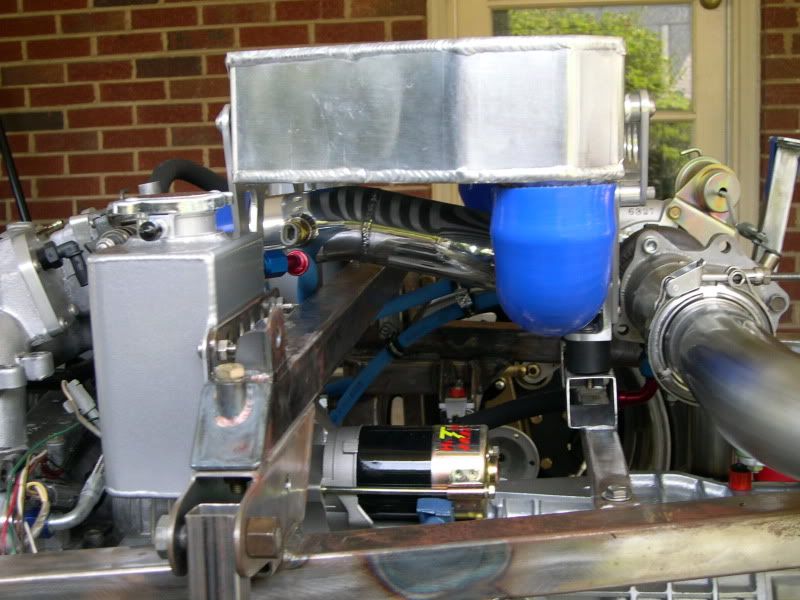
I did use the search function and though I didn't see anything specific to the stepper motor style valves, the consensus seemed to be to locate the valve inlet within the pressure side of the turbo and throttle valve. I'm at the stage of making the inlet ducting (and thought I'd finished the turbo/intercooler to throttle valve ducting!) and of course deciding what fittings and openings to install into these ducts. Looks like I'll be adding another fitting to this duct - though I'm going to look at possibly adding if off the BOV line. My installation is fairly cramped, so every hose, fitting and duct change has to be very carefully planned out!

Image

Here you can see towards the left - the black 90 degree fitting coming off the intake is the IAC inlet to the manifold. The intake duct is running under the intercooler (connecting to the blue silicone hose on the right). You can make out the IAT sensor in the duct. The IAC is located just below the duct towards the left (can't be seen in this view), and BOV connection on the opposite side of the duct from the IAT fitting. What appears to be plenty of room underneath the intercooler will be filled up with ducting - as I plan to feed cool air in from underneath, to vent out the top and through the engine cover.

Thanks again David - your insight really helped me make the call on this!

Jeff
Post Reply